Showing posts with label VW. Show all posts

Saturday, 24 October 2015

Governments have the most interesting data. Today: MOTs

There's a new web site. mot-history.net, which lets you type in any registration and make of a car and get its entire MOT history. Excluding cars < 3 years old, this means you can get the effective history of a vehicle.

This is fascinating, especially when you use it to look up the history of a vehicle you've sold on (*).


What is equally fascinating, is what is shows about things you can get away with. In particular, holding wing mirrors on with masking tape is not an MoT failure.

You can also get away with: tyres nearly worn down, steering in trouble (wheel balance?), suspension in trouble, exhaust corroded, small damage to your windscreen.

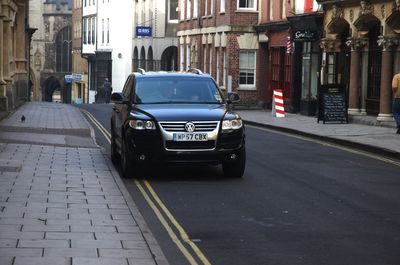
You actually have to wait a year, get those front tyres below the 1.6mm limit as it rubs slightly against the wing of the car before they say "no, time to fix the toy"

By May 2015, this car (WP53JVM, for curious), fails because bolts are missing on the wheels.


Now, you can argue about wing mirrors, suspension, etc. But driving around with bolts missing from your wheels? That's not just cause for keeping the car in the garage, that should be cause for arresting the driver for some offence related to driving in a way to endanger everyone nearby.

Anyway, it's interesting data, and you can get it for any car.

Which means you can now do some interesting data-science projects —including some which would be something schoolkids to do as "maths in the real world" projects.
  1. Look at all your friends' and neigbours' car histories and see whose is the one most likely to cause a crash. Then make a note of who never to accept a lift from, especially at night, in the rain or winter conditions.
  2. Do a census of the entire history of all cars in your road over 3 years old, counting the pass/fail ratio as well as numbers of advisory issues. Then repeat this for other parts of the city, to determine the different vehicle quality statuses of the region.
  3. We've always asserted that cars in montpelier only need wing-mirrors for the MoT. Does the data imply this?
  4. Use the historical mileage data of cars over four years old and use this to determine the average annual mileage of cars in the same streets. Is the MOT failure rate proportional to the miles across all parts of the city, or are some cars continually failing even with short mileage? Those are potentially the vehicles driven more around the city.
  5. Using that historical data, have the miles driven by residents increased or decreased after the RPZs were rolled out? What about people who don't live in an RPZ yet have jobs in the city centre or nearby?
  6. When buying a car, look up its history. It is a sign of a car that is maintained, or one neglected?
  7. Look at some lorries. Is their failure rate better or worse than other vehicles? What about vans?
The scariest thing to consider is this: the MOT certifies that a vehicle was considered safe by MOT standards for one single day. The car above could have been driving around with broken windscreen wipers, failing suspension and missing wheel bolts for 364 days before it failed its test. After being fixed, it now has another 364 days for its brake pads to finally wear too thin, tyres to wear out, those coil springs to finally corrode through.

Drivers like these are potentially some of those who complain about cyclists "not having MOTs on their bicycles". Well, with drivers like that, who cares about the state of the cyclists' bikes, other than whether or not both their brakes work? Because they aren't what you have to worry about, whether walking, cycling or driving. It's the people driving round the city in a VW golf with underbolted wheels, worn brake pads, failing suspension and defective windscreen and wipers.

To close, then: a competition for the weekend. Pick a car you see ~ 10 years old, put in its history and find out exactly what it's been failing MOTs for. We want the most dramatic reasons -and so far "missing wheel bolts on two wheels" is it.

(*) Actually it wasn't that vehicle, which was WP53JVO. Getting the last digit wrong turned up what must been another of the last batch of MkIV Golfs to leave the VW dealer.

Sunday, 27 September 2015

"VW cheated —so we need 30 mph!"


Someone called, entertainingly, Pointer2null , comments on one of our 20 mph posts and argues that:

Because VW cheated its customers and governments round the world, we need a 30 mph limit.

It's the pollution, you understand.

He cites two papers, so let's look at them.

An evaluation of the estimated impacts on vehicle emissions of a 20mph speed restriction in central London, City of London Study,  2013:

The opening paragraph says
Average speed models suggest that a lower speed limit in urban areas may result in higher pollutant emissions. However, the stop-start nature of traffic in central London means that such a method may not be suitable, and further investigation is required.
That's the scientific way of saying "its the acceleration from 0 mph that uses fuel, stopping wastes it —so simple models of constant speed are unlikely "may" to apply. Give us some more money and we'll tell you. Actually, the VW debacle has shown that some real-world experimentation would be the strategy. Fit a car with the sensors, drive round an area the month before a 20 mph rollout, then the month after -and see what changed. Back-to-back tests should be relatively accurate, though term-times and weather patterns are factors to consider.

Looking at both the 30 mph and 20 mph modes, they noted that in a 30 mph zone more time was spent accelerating (==higher RPM), while the cruise at 30 mph may more fuel efficient, its not there for very long. with slightly different roads in the study at 20 & 30, you could argue about whether the cruise and acceleration profiles would be the same at 20.

They then go on to conclude
  • It is concluded that it would be incorrect to assume a 20mph speed restriction would be detrimental to ambient local air quality, as the effects on vehicle emissions are mixed 
  •  The short-comings of using average speed models is highlighted, with the specific example of the potential to underestimate emissions of NOX from diesel passenger cars
Pollution metrics were taken off stated manufacturer levels, so, as we know: massively underestimating the pollution of the diesel fleet, while much more accurate for petrol. This means well have to discount one paragraph
Emissions of NOX and CO2 are seen to be higher over 20mph drive cycles for petrol cars and generally lower for diesel cars. PM10 emissions improve for smaller vehicles over 20mph drive cycles (less than 2.0 litre engine size), but are shown to increase for larger vehicles. The order of magnitude is such that future trends in fleet composition will be important.
The authors of the paper would really need to take the real-world figures for petrol and diesel and model the pollution levels based on those numbers, using the acceleration/speed profiles gained in this experiment. Perhaps a future paper is forthcoming.

20mph roads and CO2 emissions, The AA, Undated

This isn't a paper, more a press release. You can see it in the headline, Lower limits can increase fuel consumption and CO2 emissions. Scientists would be more circumspect, and use the word "may" in their work, especially for one single experiment.

The article is about an AA field test measuring fuel consumption in petrol vehicles. Like the CoL paper, it calls out stop-start driving and implicitly the acceleration profile, as the real killer:
  • Change 30 mph zone to 20 mph: increases fuel consumption by 5.85 miles per gallon, or 10.1 per cent.
  • Add speed humps to a 30 mph zone: increases fuel consumption by 27.3 miles per gallon, or 46.9 per cent.
It doesn't look at diesel, and the initial measurements are from the steady state "driving at 30 with no traffic jams". The Millbrook Proving Ground they mention does have a "city track",  hopefully that was the one used. A real paper would provide such information.

What it shows is that speed bumps are the enemy of breathable air. The fact that the Bristol rollout doesn't have them, must therefore be viewed as a good thing.

Comparing the AA press release with the CoL study, it is the CoL one which is scientifically defensible. They discuss the experiment in detail, how they cleaned up the data, the maths to reach the conclusions. And even in the conclusions they state their uncertainties. They are scientists? The AA: an organisation which came to the experiment with an expectation of what the answer would be, ran a field experiment which is unlikely to reflect an inner city, didn't describe that experiment very well —and came to a simple headline conclusion which failed to represent the uncertainties in the findings.

Were that to be be a paper submitted to the Bristol Traffic review team, it would have been rejected due to lack of scientific rigour.

PointerToNull, reads them and comes to the conclusion:
It's all over the news today - the NO2 figures for diesels has been faked. So this make the decision to force all petriol vehicle to observe a speed that INCREASES NO2 emissions by 8% even more short sighted (this is a measured increase by the study and not a claimed one by the makers). Given the state of diesel, petrol will probably be the dominent fuel and so in a single stroke of stupidity, all the gains made by better engine technology in petrol vehicles over the last decade has been wiped out. To press the point, the number of people who will die from air pollution will increase more than those who are saved by slower vehicles.
We're not going to disagree with anything here. They (he? she?) focus on the better of the two papers, and while skipping the "more data needed" bit of the conclusions (academics like that, it's how they get more money), makes the case that speed limits should be driven by what is optimal in terms of pollution profile.

This is a dangerous argument to use. Why? Because to say "we must choose our speed limit by optimal CO2/NOx levels", then you have to be pushing for the motorway limit to be 60 mph. Fuel economy drops significantly after that, and pollution levels increase.

Anyone advocating 30 mph urban for the sake of pollution levels, must also advocate a 60 mph limit, else they are picking data to suit their opinions.  If you did care, you won't drive short distances on cold days, or when pollution levels are already over the limits. 

Then there's also the painful fact that inner bristol's air pollution levels are beyond the legal limits, even before the 20 mph rollout, and includes the M32 corridor.


That is

-Bristol's NOx problem predates the 20 mph zone.
-it seems to correlate with some of the main bus routes: A38 and stapleton road
-it also covers the M32, which had a 60/70 mph limit in 2012.

Leaving the limits at 30 mph would have done nothing to address this problem. And while VW and friends were promising to everyone that all they had to do was wait for the Euro6 rollout, that's not going to cut it either. Which means we'll have to try other things.

The goal of the 20 mph zone is to get more people walking and cycling, not driving their kids to school in turbo-diesel cars. Then if we can get people in the core to not drive on short journeys, potentially increase traffic flow overall.

The future of urban cars is probably hybrid, maybe electric, though the economics and logistics are still dodgy there (expect some post on Tesla vs Google soon —TL;DR you'd have to be driving a lot for a Tesla to make sense; if you buy one you almost want to drive more to reduce that cost/mile). Certainly we don't need to be looking ahead to city centres with diesel, because dieselgate may be the trigger to accelerate restrictions or C-zone charges for them in Bristol, possibly starting with the RPZ.
"the number of people who will die from air pollution will increase more than those who are saved by slower vehicles.
This is potentially -and terrifyingly- true. But the response to NO2 problem should not be 'let's have 30 mph limits in town', because that will not address:

  1. The fact that with the average speed of cars in Bristol being ~16-18 mph at peak hours, even on the M32, the 20 mph limit is irrelevant at the time most cars are driven in the city.
  2. The fact that as fuel economy on motorways peaks at < 60 mph, if we want to address NOx pollution from motorways, the peak limit should drop from 70 to 60.
  3. The lack of data we have on what percentage of Bristol's NOx pollution comes from buses and taxis. If we knew, then from a pollution perspective, that could be an area to focus on.

To close then, we congratulate Pointer2null for digging up an interesting paper on the impact of 20 mph limits on city of london's pollution levels, and may email the authors asking for any planned recalculations.

Assuming that Pointer2null going to become the city's advocate of pollution-scient-driven-transport policy, we also hope to see any papers they can now dig up on effective speed limits for fuel economy and pollution on motorways. Now that £80M has been spent on the Managed Motorways, it would now be possible to drop the speed limit there on high-smog days. Having some insight into the effectiveness of this would be something to help shape regional transport policy.

Tuesday, 22 September 2015

VW TDi rigging: —but why?

The VW TDi rigging story is pretty serious; it's the third big automotive software disaster —and we haven't even covered disasters #1 and #2 yet.

Which are, for reference:

  1. Toyota's dev team being utterly incapable of writing software in accordance with modern software development practices  —with the failing accelerators being only one of the consequences of this. None of those people should ever be allowed to write code for anything more safety critical than a flash-based web advert ever again.
  2. Jeep's "Jeep Cherokee online edition", feature, where every model shipped in 2015 had a modem scannable on the network, an 0wnable infotainment console and an engine (on the same single network), whose network stack never once questioned why the mp3 player was sending messages to the transmission to turn itself off. Those engineers shouldn't be allowed to code for anything directly or indirectly attached to the Internet —which, in modern society, means they can't even code a light bulb any more (do watch that entire video for terrifyingly accurate summary of the current infosec world).
  3. VW's US TDi models detecting when they are pushed through their emissions control exam and so not being polluting for the hour or so it takes. (this would be good for MoTs actually; it would go down well with our business plan to rent VW wingmirrors for MoT tests)

Now, one of our team members does own an (ageing) VW TDi barge, and while it is frugal —even at 20 mph, we add—, it has some limitations, specifically it is a lot less responsive than the VW Passat 1.8T "wagon" which used live in the double garage up in the Pacific North West. That car had a ski box in the roof, Z-chain snow chains in the back and the ability to make it from that garage over the mountains and into in he car park of the ski resort in 2h30, —all for less than $20 of "gasoline".

Because that is the surprising thing about the US adoption of turbo-diesels: from an EU perspective, the US give away free fuel to their citizens.

Being evidence driven, here is our evidence, a receipt from ten-days into the Bristol-Traffic-strategic-meetup-with-the bay area self-driving-car/police state manufacturers. Driving, for reference a VW Jetta 2.0 16v petrol engine with automatic transmission rented for $250/week.


This is for seven days worth of commuting across mountain view, 30 miles a day,  plus the weekend leisure activities silicon valley is famous for (going to shopping malls and buying new apple hardware in the belief it will make your life more satisfying).

Assuming 150 miles over the weekend plus the commute, 30x7 + 150 = 360 miles.
The receipt is for ~13 US gallons, 27 mpg. In UK Gallons, that's 32.7 mpg. Not bad.

Now look at the total cost, $44.32 —that's £28.63. For 11 UK gallons. Which is £2.65/gallon —or, more tangibly, 58 pence a litre.

58 pence/litre? And people think the fuel economy of that car was so bad that they had to switch to a TDi model with higher economy. That is, they felt "gas" was so expensive that they had to pay a premium for an engine with more cabin noise, bounces up and down more when you are trying to text at traffic lights and whose overtaking ability, once you consider the gear-drop and turbocharger spinup will only take place once you actually hit the accelerate pedal, isn't actually that good. In contrast, a petrol Jetta is, compared to a UK petrol-engined Golf, half the price per mile and equally nimble, albeit somewhat crippled by its saloon-car design preventing it being so good for throwing things in the back or for parking in smaller spaces. You would have to be doing a lot of long-distance driving to actually justify swapping the petrol engine for the diesel turbine.

That's what VW managed to pull off with their software: not the rigging of the emissions —but the convincing of the US customer that they'd actually have a better time in a Turbo Diesel.

Wednesday, 18 February 2009

Well, it is bus-sized

The VW Tuareg WR57FJJ is taking full advantage of the parking space offered on St Michael's Hill.

It does say "Bus Stop", and any vehicle this size is half-way to being a bus, so it should have the right to park here.


It is sticking out a bit -perhaps the risk of banging the inconveniently positioned bus stop sign prevent it from using the pavement.

There's no point criticising this car; there's nowhere else in the area to park a car even for a minute on a weekday, especially not something big like a 4X4. It's not like there is a side street just round the corner with an empty stretch of double yellow line and pavement, where you would at least be letting buses get by when you parked there.

Sunday, 12 October 2008

CPZ questions?

This golf is parked in front of its garage, leaving room for a camper van in front.

Were the CPZ to roll out to kingsdown, there would be no room for the camper van. But what about the car? Does the pavement in front of a garage constitute an off-road parking area? And if so, is this house already above quota for cars, so have no ability to get a ticket for camper van?

Friday, 10 October 2008

Corner Work

While checking out parking at various schools, this VW polo stood out. Not a parent; either a resident or a commuter, parked right on the corner

Or just sticking out, as the case may be

Pedestrians should not be crossing the road here; there is a traffic island a few metres behind the camera. Blocking them from having a safe crossing reinforces that crossing here is not advised. As for cars turning into Clifton Park Road, the extra sharpness and narrowness of the turn that this car forces turning vehicles to perform -that encourages them to slow down and hence drive past Clifton High school more carefully. The car number plate, 22784, is not a UK mainland plate, but whoever they are, they have picked up the local parking vernacular.

Monday, 29 September 2008

Broad Street isn't, very


which leads me to wonder why this modest example of the People's Car that's close on half the width of the road isn't at least partially on the pavement.

Still, it does prove that it's not just Range Rovers that are immune to any implicit dangers of parking on double yellow lines. You could argue I suppose, a driver being within the car, that WP57CBX is waiting. With the engine switched off no doubt to minimise its carbon footprint.

Friday, 27 June 2008

Volkswagen AG: we care

VW do produce some low CO2 vehicles. Which they get lots of press for. A nice, friendly company that cares.

But if you look at what they like to sell, its these toys. Which are entirely unsuited to Bristol, both in parking and general all round driving. Yet their sheer impracticability makes them a wonderful status symbol. If you can afford this, you have somewhere spacious to park it; you can afford lots of fuel. If it was affordable and sensible, it would not be a status symbol.

Why do VW sell them it? Well, with a selling price of 3-4X a polo the margins are fantastic. Also, the official servicing charges are double for everything you'd ask the company to do.


Here we see what must be a collection of VW dealers at the Hotel du Vin, showing how much a positive contribution the VW product family makes to the city.


Note also that Porsche is planning to/has taken is share of Volkswagen AG above 50%, so they now own the company. That's the same Porsche who were fighting the plans for London to charge extra to group G vehicles entering the congestion zone -even those of residents. No doubt the Touareg fleet will also benefit if Boris scraps this change.

It was very tempting to go into the hotel and notify them that I'd just reported their pavement parking to the council and they had 15 minutes to move their toys off the pavement, but I didnt have time to hang around and watch the consequences.