Ever since Elvis first went on stage wearing underpants a size too small causing a lack of blood flow to his knees, resulting in what was to become his trademark dance moves, music has always aligned itself with forces of evil and sin. You'd think that with modern technology and advances in manmade fabrics times would have changed, but no.
If you need proof then you need look no further than popular music act "30 Seconds To Mars" and their latest insult to our ears, eyes and sense of moral decency.
Not only do they underestimate our intelligence by providing us with a music video that is almost 9 minutes in length when their proposed trip to Mars is only thirty seconds, the video appears to be promoting cycling on public tax funded roads. Not just any cycling either. At numerous points in the video the bicyclists can be seen blatantly riding more than two abreast, lacking any sort of helmets or high viz attire, and I'm sure at one point someone can be seen riding backwards without using the appropriate hand signal. They then have the nerve to use an altercation with a car as the crux and dramatic turning point for the video when it's obvious that the only reason the altercation occured is because the cyclist wasn't wearing a helmet rendering him very difficult to see.
Well, "30 Seconds to Mars", I hope you're pleased with yourselves. I have just one thing to point out to you. When you do start making your journeys to Mars, you might find it actually takes a little bit longer than 30 seconds on a bicycle. Think on.
http://www.youtube.com/watch?v=9VhZDiG7ye0
Showing posts with label safety. Show all posts
Showing posts with label safety. Show all posts
Thursday, 12 November 2009

Saturday, 21 March 2009
Safety Feature
The van K329PHW parked in the bike lane just by the Stokes Croft/Ashley Road junction is making the junction safer for bicycles.

That lane is a way to die, as the left turn lane is to the right of it. If a bike turning left comes up the inside of a car which turns over it, death. If a bike tries to go straight on while a vehicle turns left, death. The safe option for this junction is to acquire and retain the entire left hand lane, then either turn left or go straight on (into the bike lane there), as appropriate. Yet the signage misleads bicycles and sets up the wrong expectation in cars

That lane is a way to die, as the left turn lane is to the right of it. If a bike turning left comes up the inside of a car which turns over it, death. If a bike tries to go straight on while a vehicle turns left, death. The safe option for this junction is to acquire and retain the entire left hand lane, then either turn left or go straight on (into the bike lane there), as appropriate. Yet the signage misleads bicycles and sets up the wrong expectation in cars
- By parking where it has, the van makes it clear to cyclists that they should not be in that lane.
- By taking up half the left turn lane, the van stops cars, buses and lorries from using that lane
- Therefore, it the lane becomes a bike-only lane. This is exactly what you need to get out of this junction alive.
Wednesday, 31 December 2008
Tampering with Speed Limiters
Some researchers up in Leeds have published a study of GPS-speed limiting cars.
The central cycling groups are in favour of it -because the idea of cars not speeding appeals- and the "unionists" -the Association of British Drivers and their anti-speed-camera allies are against it.
Bristol Traffic leaves it up to individual contributors to have their own opinions. But this one, the Computer Scientist in the group, is against it on software engineering grounds:
As it is, the closest we have to speed limiting infrastructure we have today are the tachographs in lorries, that monitor speed and working hours. Which is why Ross Anderson's wonderful book Security Engineering has a section on subverting tachographs, right between Banking and ATM security and locking down Nuclear Command and Control Systems so that high-energy physics events only take place with senior management approval.
Trying to limit vehicle speeds from an bit of in-car electronics and GPS is as workable as the film companies trying to restrict DVD players to specific regions so they can charge price differentials on different continents (result: multiregion players cost a 10 pound premium). It's as workable as the games console companies trying to stop you hacking into the controller so you can play downloaded games burned onto your own disks. Results: modified firmware chips are widely available. These consoles are not easy to hack, either; it took someone at MIT three weeks to 0wn the Xbox. If there is money to be made from subverting something in your possession, be it a games console, a DVD player or a tachograph, then someone will do it. And if the hack is a software one, then it usually scales well. Only one person will need access to the Scanning/Tunelling Electron Microscope, the rest just pay for the results and some modified firmware.
Imagine that three years from now, every car comes fitted with mandatory speed-limiters driven by GPS. How would you attack it?
Attack one: lie about your location. Civilian GPS isn't secure; it isn't signed and anyone could generate spoof satellites. An in -car pocket GPS Jammer would generate signals telling the satnav unit that you were in France or Germany and could drive as fast as you like. This is a good attack as when the jammer is off: it doesn't show. When the speed limiter is checked in the MOT, all would appear well.
Attack two: firmware hacking. All embedded computers with upgradeable software can be subverted with new firmware. There may be some checks on the firmware -that it is digitally signed by someone trusted-; these need to be subverted first. If you can roll back to the legit firmware during the MOT tests, nobody will know.
Attack three: hardware patching. The common games console attack. Shows up in a physical audit.
Attack four: don't update the maps. Assume that every year, speed limits come down. There is no benefit, then, in updating your maps. Snap the link to the GSM modem, or refuse to pay the 10 pounds/year for updates. If the MOT checks that you are up to date, someone needs to record the previous year's update, and after the MOT, you replay the older map into the SatNav.
Attack five, and this is the fun one: generate fake maps. Create one that says the max speed for the country is 120 mph. Install it in your own machine, sell it to others. At this point the security experts are going to say "ah but our system will only download signed maps from a trusted provider". Which may be true, but rests on certain assumptions about the security of things like HTTPS, those web sites with the green bar in the browser window, which tell you that that bank site really is who they say they are, and not some russian Phishing site. On the same day that the UK government published their paper on SatNav-based speed control, a group of Dutch hackers published a lovely paper on how to subvert HTTPS by creating a fake certification authority. It's a fairly complex paper and hard to understand, the good news being none of us need to know the details. What is important is that people like Ben Laurie, key developer of the OpenSSL stack and Apache SSL module is scared. Because right now, this week, we can't trust HTTPS sites to be who they say they are. There are very serious implications for the web for this, but they would also impact things like satnav based GPS. If I could make a fake map that removed all speed limits from cars sold after 2012, how much would it be worth?
If SatNav-based-speed limiting is flawed, what to do? Well, why not charge a bit of road tax based on peak vehicle speed? Or just speed limit all cars to 100 miles an hour, more than enough for UK overtakes and driving -and to get you to the French Alps when needed- but removing demand for big-engined cars that waste petrol at normal speeds. Or rely on the ANPR-instrumented motorways to catch speeding cars, and similar infrastructure in-city. Because you are going to need such cameras up to keep an eye on the older cars, the cars from the rest of europe, and to detect people who have just paid for my high-speed map of the country. There are lots of options that don't rely on tamper-proof hardware being embedded in cars with tamper-proof maps and reliable GPS constellation data received in real-time. It would be one of those things like biometric ID cards: a expensive way to not solve the underlying problems.
The central cycling groups are in favour of it -because the idea of cars not speeding appeals- and the "unionists" -the Association of British Drivers and their anti-speed-camera allies are against it.
Bristol Traffic leaves it up to individual contributors to have their own opinions. But this one, the Computer Scientist in the group, is against it on software engineering grounds:
It is one thing to have SatNav give you hints as to where to drive -hints you should consider but not follow blindly, another to be relying on GPS and accurate mapping data to control your vehicleThe Leeds study took volunteers and explored how voluntary and mandatory speed limiting worked, then interviewed various people to see what they felt of the idea. What they did not attempt to do was impose speed limiting systems on unwilling participants, people who wanted to drive fast. Doing so would not only show how acceptable the idea was to the country at large, it would show how willing people were to subvert the system. A realistic study would therefore instrument a city's taxi/minicab fleet (I can think of a city), or all drivers convicted of speeding coming off a driving ban.
As it is, the closest we have to speed limiting infrastructure we have today are the tachographs in lorries, that monitor speed and working hours. Which is why Ross Anderson's wonderful book Security Engineering has a section on subverting tachographs, right between Banking and ATM security and locking down Nuclear Command and Control Systems so that high-energy physics events only take place with senior management approval.
Trying to limit vehicle speeds from an bit of in-car electronics and GPS is as workable as the film companies trying to restrict DVD players to specific regions so they can charge price differentials on different continents (result: multiregion players cost a 10 pound premium). It's as workable as the games console companies trying to stop you hacking into the controller so you can play downloaded games burned onto your own disks. Results: modified firmware chips are widely available. These consoles are not easy to hack, either; it took someone at MIT three weeks to 0wn the Xbox. If there is money to be made from subverting something in your possession, be it a games console, a DVD player or a tachograph, then someone will do it. And if the hack is a software one, then it usually scales well. Only one person will need access to the Scanning/Tunelling Electron Microscope, the rest just pay for the results and some modified firmware.
Imagine that three years from now, every car comes fitted with mandatory speed-limiters driven by GPS. How would you attack it?
Attack one: lie about your location. Civilian GPS isn't secure; it isn't signed and anyone could generate spoof satellites. An in -car pocket GPS Jammer would generate signals telling the satnav unit that you were in France or Germany and could drive as fast as you like. This is a good attack as when the jammer is off: it doesn't show. When the speed limiter is checked in the MOT, all would appear well.
Attack two: firmware hacking. All embedded computers with upgradeable software can be subverted with new firmware. There may be some checks on the firmware -that it is digitally signed by someone trusted-; these need to be subverted first. If you can roll back to the legit firmware during the MOT tests, nobody will know.
Attack three: hardware patching. The common games console attack. Shows up in a physical audit.
Attack four: don't update the maps. Assume that every year, speed limits come down. There is no benefit, then, in updating your maps. Snap the link to the GSM modem, or refuse to pay the 10 pounds/year for updates. If the MOT checks that you are up to date, someone needs to record the previous year's update, and after the MOT, you replay the older map into the SatNav.
Attack five, and this is the fun one: generate fake maps. Create one that says the max speed for the country is 120 mph. Install it in your own machine, sell it to others. At this point the security experts are going to say "ah but our system will only download signed maps from a trusted provider". Which may be true, but rests on certain assumptions about the security of things like HTTPS, those web sites with the green bar in the browser window, which tell you that that bank site really is who they say they are, and not some russian Phishing site. On the same day that the UK government published their paper on SatNav-based speed control, a group of Dutch hackers published a lovely paper on how to subvert HTTPS by creating a fake certification authority. It's a fairly complex paper and hard to understand, the good news being none of us need to know the details. What is important is that people like Ben Laurie, key developer of the OpenSSL stack and Apache SSL module is scared. Because right now, this week, we can't trust HTTPS sites to be who they say they are. There are very serious implications for the web for this, but they would also impact things like satnav based GPS. If I could make a fake map that removed all speed limits from cars sold after 2012, how much would it be worth?
If SatNav-based-speed limiting is flawed, what to do? Well, why not charge a bit of road tax based on peak vehicle speed? Or just speed limit all cars to 100 miles an hour, more than enough for UK overtakes and driving -and to get you to the French Alps when needed- but removing demand for big-engined cars that waste petrol at normal speeds. Or rely on the ANPR-instrumented motorways to catch speeding cars, and similar infrastructure in-city. Because you are going to need such cameras up to keep an eye on the older cars, the cars from the rest of europe, and to detect people who have just paid for my high-speed map of the country. There are lots of options that don't rely on tamper-proof hardware being embedded in cars with tamper-proof maps and reliable GPS constellation data received in real-time. It would be one of those things like biometric ID cards: a expensive way to not solve the underlying problems.
Monday, 23 June 2008
The parked BMW is providing a valuable safety service
This black BMW on stokes croft may appear to be a classic example of a selfish car driver, more concerned with a short walk to their destination than the safety and convenience of others. By blocking the bike lane it forces cyclists into the single lane highway alongside it.
But in fact, this is a safety facility.

Because look the other way. As the junction is approached, cars pull in to the bike lane before making a left turn. If you were cycling down there, you'd be at risk of having the left-turning vehicles squashing you.
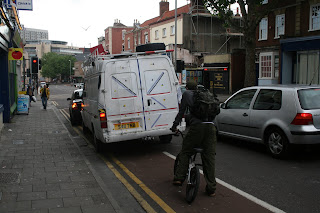
By making you merge into the single lane -and stopping that left turn lane beginning early, the BMW is creating a safe junction for everyone. Which goes to show -appearances can be deceptive.
But in fact, this is a safety facility.

Because look the other way. As the junction is approached, cars pull in to the bike lane before making a left turn. If you were cycling down there, you'd be at risk of having the left-turning vehicles squashing you.

By making you merge into the single lane -and stopping that left turn lane beginning early, the BMW is creating a safe junction for everyone. Which goes to show -appearances can be deceptive.
Subscribe to:
Posts (Atom)

 Posts
Posts

