Showing posts with label traffic-calming. Show all posts

Wednesday, 4 July 2012

The battle for Hurlingham Road

In the on-going war against motorists, those tax-dodger loving folk at Bristol City Council, led probably by Col. Jon Rodgers, recently permanently blockaded our lovely little rat run, Hurlingham Road, allowing access only for cyclists and pedestrians.

This provocative act of madness unilaterally curtailing our right to tear up the road in the rush hour, watching cyclists, buggy toting parents, cats and dogs scatter in shock & awe, should not go unopposed. Indeed, it did not.

Some of us in the HVF (The Hurlingham Volunteer Force) tried to restore the natural order, very soon after only the kerbstones had been laid, by driving straight over them. This worked for a while, but then the enemy cemented in black bollards. So, as my 2IC reports, some of us had to resort to driving half on the pavement and half over the kerbstones.

It was fun, while that lasted, seeing the untermensch taken out of their comfort zone and only avoiding becoming collateral damage by walking in the centre of the road - the confusion in their eyes so touching.

However, the enemy counter-attacked by sinking in wooden poles adjacent to the bollards. Now, with their barricades are fully built, there is no way we can get through. However, this particular battle may be lost but with proper guerrilla tactics we can still disrupt the real enemy: the cyclist.


One of our soldiers, who for operational reasons will only be known as White Van Man (Rank: Superior, Number: KV08WDZ) deserves special mention in this dispatch. Using all of his field skills, he has blocked any two-wheeler from accessing their little apology for a rat run. Cleverly he has left a little gap on the left to make it appear as if there is room to get through, but when the hapless cyclist gets close he'll realise that there is no room to cycle straight through. Priceless. The fightback continues ...

(photos and text from "BK")

Saturday, 13 August 2011

Walthamising Hotwells

One of the Clifton Traffic Calming proposals -voted for, with support from the Waltham Forest Faction of the ruling LibDem party, was to remove some yellow lines from this road "to calm traffic", with a key justification being this is near a school and it would improve safety. This perfect Walthamisation: to improve the facilities for us, the motorists, using the walking and cycling part of the council budget, and claiming it is for "their own good". Waltham Forest excels in this, such as in the downgrading of a route to the Olympics, though we are surprised at how much it cost to make it so easy to PavePark. We in Bristol don't need such help.

This is the road covered. There are some buildouts already, one positioned to protect the wingmirrors of cars, and room on the other side of the road to park. The target area must be further down the hill.


Ah yes, here it is. A narrow stretch, two chicanes and then a wide space -wide enough to get two small cars into.


But here's a question: is this worth spending political capital on? Barbara Janke, Cllr for Clifton (Waltham Forest Ward), is in charge of a minority council that often cites its green foundations as a way of differentiating it. To remove some double yellow lines "to calm traffic" is going to get bad press in the green-troublemaker news outlets (fortunately, not the BBC or Evening Post), and embarrass others in the council. For what? Two parking spaces.

It may seem odd, but we in the Bristol Traffic project are against the proposal for two reasons. One is this: there are more important places to add parking areas that a back road near Hotwells

The other --and this is key-- is this: double yellow lines provide Clifton parents with designated dropoff areas on the school run. Those two parking spaces would be wasted on residents or commuters, as only two people a day will benefit from each new space; four people per day on a weekday, dropping down to one person/day on a weekend. Twelve vehicles a week. Whereas as a short-stay parking area, you could have ten parents a morning queuing up to do dropoffs, push the kids out and carry straight on into the city, without having to get out the car.

It is far more valuable for parental dropoff than for resident and commuter parking, and if the councillors don't realise this, they are talking to the residents and not the school parents. If we sent our kids to this school, we'd be in touch with Barbara Janke and others defending our right to park here, instead of saying "yes, we think two more residents should park here." Who cares about the residents? That's four voters, compared to the possibly twenty that ten families could offer.


The other thing is that traffic calming claim looks, well, weak. You could push it for Pembroke Road -you can get up to speed. But here? Even with a buildout dropped enough to let vans go over it, you can't keep your speed up, you have to give way at the bottom anyway.

For the sake of twelve extra vehicle parking opportunities a week, Barbara and Terry are going to make enemies of everyone in the school, as well as devalue the entire "LibDem are green" brand. Admittedly, their Westminster School and Parliament compatriots are doing the same thing, but if you look at the recent election results, not only did the Green party take a LibDem seat, they came second in a few other wards. The cost of adding two parking spaces here -both financial and political - doesn't justify it. Two happy residents, some commuters who aren't even in the same ward as the councillors, and 40-50 annoyed parents plus the local green troublemakers blogging about it -and maybe even letting the evening post in on the joke, so that Barbara gets laughed at as much as Gary "bus stop" Hopkins did.

This is just political ineptitude.

Wednesday, 10 August 2011

Pembroke Road: where should Barbara Janke remove the yellow lines?

Barbara Janke, leader of the council (at least for the next few days)- has taken on the challenge of ensuring that traffic safety "can be improved" by adding extra car parking in Clifton. Of course, we, the tax-payers, know that this is technically "bollocks", but we also know that anything which discourages walking and cycling does reduce the numbers of Killed and Seriously Injured, so provided you don't actually measure foot and bicycle traffic, you can claim improvements. This is the tactic used by central government to claim that the UK's roads are safer than ever, so there's no reason why the Clifton Councillors can't use it.

First, the bottom end of Pembroke Road as it approaches Queen's Road. Look at that -two wide bits of parking area, almost completely wasted. Only one vehicle has dared to pre-empt the proposed removal by doing a bit of paveparking -and they were only loading up.

In the other direction, a happy family walks over the zebra crossing.
Look how much parking space is being wasted here! Not only is there a zebra crossing -encouraging people to endanger themselves by walking- the zig-zags are taking up space for at least eight cars.

Some readers are thinking "more than eight cars", but this is Clifton, remember. Big cars, for important people, like Ranger Rovers, BMW X-series toys. Some of the students do have smaller cars, but Mini Coopers are acceptable -provided they are the new BMW version, not the old British Leyland editions.

If Barbara wanted to live up to the expectations of her local electorate, especially the Keep Parking Free team, she should remove not just all the yellow lines in these photographs, but the zebra crossing too. This would allow much more parking, and hence more traffic calming

Sunday, 15 May 2011

Does extra parking calm traffic? Yes

We're going to be looking at the Clifton "calming traffic through more parking" plans, to show that this isn't really a self-centred proposal by the Clifton Parking Faction (our comrades, the Keep Parking Free team), but instead a dedicated attempt to reduce risk in a busy city.

Here is the Shaldon Road/Muller Road Junction. Our secretly camera-instrumented traffic dodger is not waiting the ASL we paid our tax money for, apparently because "you get run over by buses turning left on the left turn light, or buses turning right"


  • At 0:04 a car parked with its hazard lights on, some L-plate vehicle, we believe.
  • At 0:08 the tax-dodger pulls up to go straight on, even though there are no markings on the road to indicate that this is permitted.
  • At 1:23 in this dull video (and people wonder why we text in our cars at junctions. This is why), a bus turns right.
  • At 1:27, behind the camera, the bus comes to a halt, as it cannot get past the parked car, not with the queue of cars waiting to turn right.
  • At 1:31 someone sounds their horn. We are not sure who. Either its the silver car behind the bus, or a car behind the bicycle complaining that they are in the way.
  • At 1:40 there are now five cars behind the bus, the traffic speed has been reduced to 0 km/h. No pedestrians will get hit by cars now.
  • At 1:46 the green light reaches Shaldon Road, the tax-dodger pedals forward through a junction that is now blocked by stationary cars. Any cars behind them will not be moving, hence their speed is also 0 km/h: again, safety at work.
  • At 1:50 the known subversive weaves their way through the now traffic-calmed junction, so ensuring that if there were any pedestrians in Station Lane, they would not get run over by a speeding cyclist.
There we have it then. A single L-plated car can traffic calm a busy junction, reducing vehicle speeds by 15 km/h, that is, from 15 km/h to 0 km/h.

This shows how the addition of extra parking spaces can calm hazardous junctions, and is not merely an attempt by a group of self-centred Clifton residents to add extra parking for their extra vehicles. Although that is, of course, a side-benefit, one that other traffic calming ideas: bike parking, trees and build-outs don't over, which is why it is the only form of traffic calming that we, the Bristol Traffic team approve of.
Update: added the video

Sunday, 6 September 2009

Traffic Calming the Railway Path

The greenbank development has surfaced again, with the developers asking for more input on their plans to build houses straight on to the path. The previous proposal was rejected by the community as having 20 paths opening on to the path was felt to be dangerous.

This time the community has the option of the same number of paths, or half as many, with the option of traffic calming. Oddly enough, there is no option to reject the proposal, which is clearly a bug in the web page design. It's tricky, getting those <select> buttons right.

Friday, 5 September 2008

Traffic calming the bike route

That little bike crossing in Montpelier between Richmond Road and Picton Street is dangerous. Bikes heading onto Richmond Road pull out with no warning, and could run into anyone coming down the hill -including other bikes.

The people who care most about this danger appear to Montpelier's 4X4 users, who do their best to control bike speed by blocking the exit. Nobody else nearby cares -they are too selfish, choosing to park near their houses rather than park in a way that would reduce the risk of road accidents and make the district a safe place to walk and cycle -as this Mercedes, H19ODG, is doing.

Thursday, 28 August 2008

Ideas for Bristol: traffic calming on bike routes

As well as photos/videos of Bristol, we also welcome photos of ideas that could be adopted in our fair city. As it is the holiday season, there should be lots of improvements to pick up.

Here is a bit of Lôn Las Ogwen. This is a lovely route which takes you from sea level to 300+ metres, by LLyn Ogwen and below Tryfan, right in the heart of Snowdonia. The path may run up the same valley as the A5, but it does it along a river, through a slate quarry and with sheep on the road being the main traffic hazard. Apart from that 300m of ascent -mostly at a a steep bit- its a good family ride. Not very busy either, people could come out and enjoy it more.

Except not, of course, in bikes with trailers, tagalongs or any other child towing configuration. No recumbents either. Because there these little Z-bend entry points on the path that take about ten minutes worth of bike wiggling to get through, with the main bike being lifted up to the back wheel, the kid lifting his part through. Its enough to put you off cycling here with kids.


Which may actually be the intent, as the yellow sign says -in welsh and english- 'danger do not allow your children to play here'.

It's not clear who funded this junction and signage, sustrans don't go out of their way for such designs. Perhaps either the local slate quarry or council felt they needed to discourage cycling.

Wednesday, 6 August 2008

Traffic Calming bicycles

Here are the two range rovers of Montpelier, using the other side of the only bit of Montpelier where there is room for them.

The black one is parked on a double yellow line and half way onto the pavement. Normally this would be considered somewhat naughty, but here they are forcing bikes to zig-zag across the bike only cross, and so approach Picton street at a safer speed and angle, as these bikes are doing.

That's why residents cars are such a valuable contribution to the city: our cars provide traffic calming that the city lacks. Who knows how fast these bikes would hit a busy street were it not for this selfless contribution?

Thursday, 31 July 2008

Montpelier mixed-use area

Here's a lovely shot of evening Montpelier. Three kids cycling round the street; two adults pushing the bikes up the hill. Further down Richmond Road there are some more people walking in the middle of the street, carrying shopping bags. A taxi will nudge its way up the hill, but carefully, rather than the 35+mph that is their ideal speed.

This street effectively makes Montpelier Bristol 's first people-first-cars-second area. And to achieve this, the residents didn't need any contributions from Bristol City Council. Instead they came up with their own goal - a safe place to walk and play- and a simple strategy to achieve this.
What did they do? Well, if you look at the edges of the picture, you can see it. Along each side of the road, completely blocking every pavement, is a near-continuous line of cars. This forces pedestrians into the street, but the cars are positioned such that the road is too narrow to drive fast. If the parked cars were not here, through traffic would speed, and the children would be constrained to the pavement, rather than being able to enjoy the whole width of the street. And, as they are cycling, that would increase the risk of pedestrian/cycle collisions, which as we all know, is the greatest danger facing this city.
It is contributions to innovative road design like this that make Montpelier a leading part of "Cycling City Bristol"

Monday, 21 July 2008

East Street: a secret short cut

There is a secret back-route through Bedminster that only a few cars know about it. Here we are going to blow the secret wide-open and share a way to skip three traffic lights and about ten minutes on a weekday morning.

It's called the East Street pedestrian zone, here demonstrated by -----. It may say buses only, but as we've seen before, that's a hint. Any law that isn't enforced doesn't exist, and as driving through here in a car is never punished, you may as well. So who wastes time going round the back streets of Bedminster, when they could punch the core at speed? Losers.

Friday, 18 July 2008

MOD path improvements: MTB race training


Mountain Bikers will be pleased to see that the MOD have just added a race training obstacle to their course; a left hand bend where you arc through the vegetation before hitting the road at race speed:


Overtaking through vegetation is actually an effective race technique, though you have to have speed before committing as you shouldn't pedal during the operation -too much risk of plants getting into the drivetrain.

For those cyclists who do the Filton-city centre run on a regular basis, this is welcome. Currently only the Lockleaze to St-Werburgh's route has anything in terms of offroad entertainment; making the through-MOD route more technical would make it less dull. Some people may argue that in fact South Gloucestershire Council, as part of the Cycling City initiative, would actually want to make the route better to cycle, but they are missing the point. Bike lanes are not for bicycles. They are either to keep bikes out the way of cars -by putting them in the way of pedestrians- or they are part of section 106 inconveniences which companies have to pay for when they build big things.


(thanks to Shawn for this photo)

Tuesday, 15 July 2008

If the junction had visibility, it would be boring

Here's another example of how Bristol is leading the way in community-initiated traffic calming.

By parking across the junction,approaching vehicles cannot see ahead, and are forced to slow down and proceed with caution.
It also forces cyclists to merge with the car traffic, so eliminating the dreaded "car turns left over bike" collision, which is such a recurrent problem with bike lanes and other car/bike segregation experiments.

Many thanks to blue van WR56FME, sponsored by TGI, for this piece of much needed traffic calming.

Sunday, 13 July 2008

Bike Lanes Near Annecy

For contrast, here is a bike lane near Annecy, France.

It is designed so that road cyclists and rollerbladers can proceed at top speed down the path

A small gravel area on the side with a "pedestrian marking" shows the area for mountain bikes to have fun in, though there are no jumps or other technical obstacles to make it very interesting.

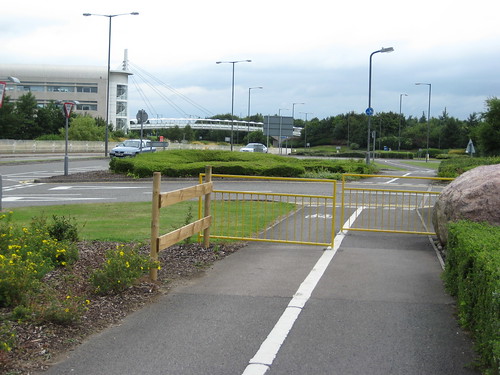
At the actual junction there is an offset barrier which allows roller bladers to zig-zag through at full speed

While bicycles have a slightly harder chicane-style solution to the problem of crossing the road without stopping.

Saturday, 12 July 2008

Oxford 5: enforcing give way junctions on bike paths

One recurrent problem with on-pavement bike lanes is that they lose the right of way at access points to the road. If you were cycling along the road, cars would be required to wait for you while they were pulling on or off the road. But on the pavement, you are expected to stop. Which makes them less efficient for cycling, unless you ignore the give way signs.
Clearly in Oxford, the students have been doing this, so the fact that bikes were meant to give way had to be backed up by something more substantial. In this case, a large iron bar across the bike lane appears to do the trick

Now fast moving bicycles are forced to swerve into the oncoming bicycle lane before crossing the junction at exactly the same speed as they would have done before.

This shows precisely why bike lane design is a highly skilled task left to professionals. An amateur would have looked at this and described it as useless. A professional traffic planner would have collected data on throughput and velocity, run simulations on risk of injury before and after the bar was put in, and demonstrated that having a metal bar across an unlit bicycle lane was in fact safer for cyclists.

Tuesday, 8 July 2008

The Cotham Brow traffic free zone

The experiment in making Cotham Brow nearly 100% traffic free continues. When these photos were taken, it was blocked to everyone but buses, locals and taxis in a hurry.

As a result, the whole of Cotham is much quieter. By blocking the main route through the area, you can see that most traffic is through traffic, not local.


And interestingly, people walk on the street. It becomes somewhere pleasant to be, somewhere you can cycle without worrying about pulling out in front of the taxi or the oncoming bus.


It is a lovely place to visit. Enjoy it while it lasts. It looks like the traffic calming is moving South towards Horfield Road next.